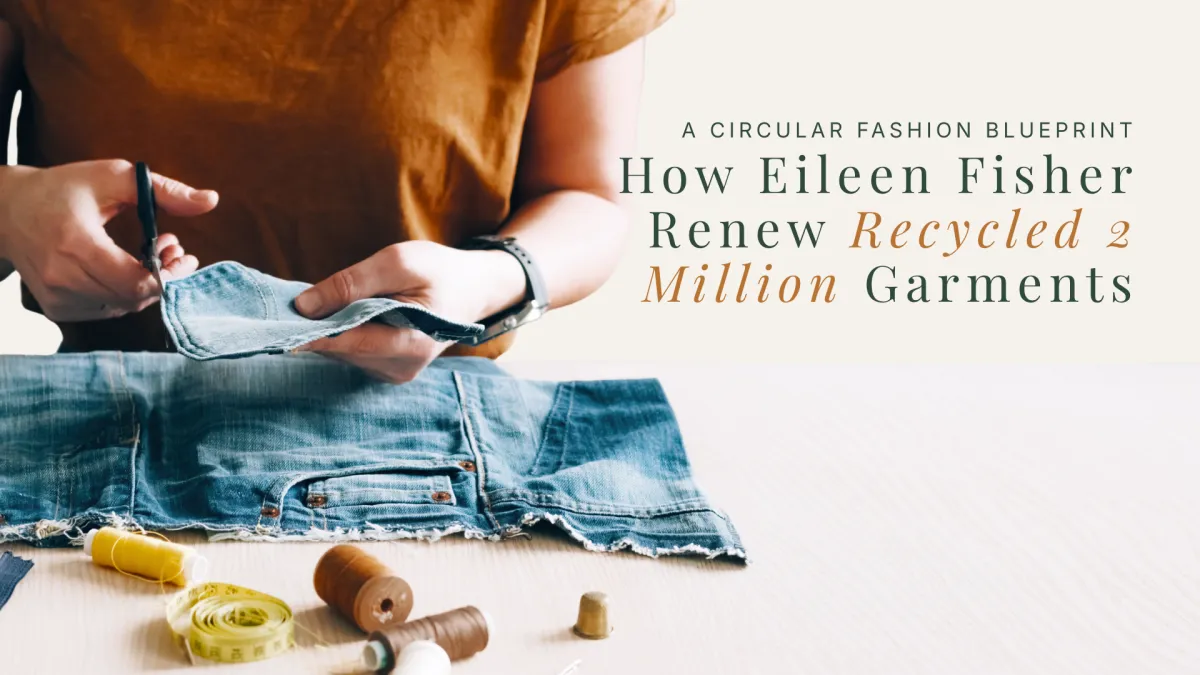
How Eileen Fisher Renew Recycled 2 Million Garments — A Circular Fashion Blueprint | Amalé
The $5 Return and the Reality of Intake Operations
In a quiet warehouse in Irvington, New York, a cardboard box arrives. Inside is a black boiled wool vest, worn at the edges but structurally sound. The customer who sent it back received a $5 credit. The amount is modest. The operational work behind that return is not.
This is the intake process at Eileen Fisher Renew. Since 2009, the program has collected more than 2 million garments. That number matters because each item has to be received, inspected, sorted, and routed into a next step. Resale. Repair. Remanufacture. Recycling. Nothing about that flow is abstract.
While much of the industry spent the last fifteen years optimizing for new production, teams in Irvington and Seattle were learning something else. How do you assess an older garment quickly and accurately. How do you determine whether the fabric can be repaired. How do you handle inconsistent wear, missing labels, fiber blends, stains, and damaged seams without losing margin or process control.
Renew turned product recovery into repeatable product lifecycle management.
In an era of hyper automation, Renew is a lesson in operational precision. Every garment is touched, inspected, and categorized by a person who understands fabric behavior and end of life constraints. This is not just a story about care. It is a story about systems that make care executable.
The Tiny Factory: Where Product Decisions Become Operational Decisions
When a garment is too damaged for simple resale, it moves to what the brand calls the "Tiny Factory." Here, the transition from product to material is handled with operational precision.
The artisans here are not just seamstresses. They are decision makers working with constraints. They assess whether a stain can be over dyed, whether a torn panel can be replaced, and whether a damaged wool garment can be transformed through felting into another viable use. Those calls affect labor time, material recovery, resale value, and downstream waste.
This work does more than divert material from landfill. It creates skilled jobs and keeps technical knowledge in the community. It also shows the real cost of circular operations. Someone has to inspect the garment. Someone has to repair it. Someone has to document what happened to it. For brands, that has direct operational impact. Better product data, cleaner material inputs, and stronger traceability reduce friction. Poor labeling and mixed fibers increase cost and limit recovery options.
What This Means at Scale
If we zoom out from the workbench in New York, the larger problem becomes clear. Globally, estimates suggest 85% of textiles end up in landfill or incineration. That statistic is not just a waste story. It is an operations story. It reflects an industry built for linear throughput rather than product recovery, repair, reuse, and material recapture.
The Eileen Fisher model matters because it shows what changes when a brand treats garments as managed assets rather than one time transactions. Intake becomes more structured. Sorting rules become clearer. Repair pathways become part of planning. End of life decisions become part of product lifecycle management instead of an afterthought.
It also shows the limits of doing this without strong systems. A return program can begin as a brand value initiative. At scale, it becomes a logistics, data, labor, traceability, and compliance function. The shift from linear to circular models requires operational discipline across design, sourcing, labeling, inventory, customer returns, lifecycle management, and downstream partner coordination.
That shift has visible impact. Workers need clearer information to process goods safely and accurately. Brand teams need less guesswork at the SKU level. Finance leaders need a realistic view of cost, recovery, and compliance exposure. Circularity only scales when the operating model changes with it.
That is the turning point now facing the broader market.

The Turning Point: When Voluntary Programs Become Mandatory
For fifteen years, Eileen Fisher operated Renew as a choice. Under SB 707 and the EU Digital Product Passport framework, that operating discipline is moving from optional program design into mandatory compliance.
Under California’s SB 707 and the EU’s Digital Product Passport framework, the practices that once sat inside voluntary take back and resale programs are moving into mandatory compliance territory. Brands are being asked to verify what products are made of, support end of life pathways, and maintain the records needed to meet regulatory obligations.
That distinction matters. Voluntary programs allowed room for experimentation. Mandatory frameworks require consistency, documentation, traceability, and audit readiness.
The challenge for the tens of thousands of brands impacted by SB 707 is that most do not have a fifteen year head start. They do not have the Irvington warehouse or the Tiny Factory. They have fragmented supplier data, inconsistent material records, and limited visibility into what happens after the point of sale.
This is where ecosystem roles need to stay clear. Landbell USA serves as a Producer Responsibility Organization (PRO) that supports compliance under SB 707. Amalé Technologies serves a different role. We provide infrastructure that helps brands execute the operational side of that requirement through data management, product traceability, lifecycle management, and workflow support.
To scale a program like Renew, brands need a reliable record of every garment. They need to know what it is made of, how it can be repaired, and which downstream partners are equipped to handle it.
Where Amalé Fits: The Circularity Engine™
Amalé Technologies fits into this ecosystem as compliance infrastructure. Landbell USA serves as a Producer Responsibility Organization (PRO) that supports compliance under SB 707. Amalé helps brands operationalize the work required to respond.
Our Circularity Engine™ is built to support the how. It helps brands organize product data, prepare for Digital Product Passport requirements, improve traceability across the portfolio, and create cleaner handoffs between internal teams and downstream partners.
In practical terms, that means supporting capabilities such as:
Traceability: Knowing material composition and product attributes at the level needed for repair, reuse, recycling, and compliance reporting.
Operational record keeping: Maintaining reliable product and lifecycle data that can support internal decision making and external compliance needs.
Partner coordination: Creating clearer pathways between brands and the repair, resale, recycling, and stewardship networks involved in end of life management.
This is not a substitute for regulators or stewardship organizations. It is the infrastructure layer that helps brands manage the operational reality underneath the requirement.
The Takeaway for the Forward-Looking Brand
If your organization is looking at the 2026 to 2028 regulatory horizon, the Renew model offers clear operational lessons:
Standardize product level traceability inputs: Document which systems hold fiber content, trims, care instructions, supplier records, and ownership by SKU.
Verify material composition at the SKU level: Validate material declarations against product specifications so repair, recycling, and compliance decisions are based on product specific data.
Qualify regional repair and recycling partners now: Confirm which partners can process which materials, in which markets, and under what intake conditions.
Build lifecycle management into product development: Require clearer material choices, labeling standards, and documentation so products can be recovered, repaired, and routed with less friction.
Implement mandatory record keeping workflows: Define how teams capture, update, and retain documentation for SB 707 and EU DPP obligations.
The Call Forward
The 2 million garments returned to Eileen Fisher are not just a signal of customer intent. They are proof that circular operations depend on disciplined intake, clear product data, skilled labor, reliable traceability, and dependable downstream pathways.
As the industry moves into an era where circular obligations are becoming mandatory under SB 707 and the EU Digital Product Passport, the question is not whether brands care about product recovery. The question is whether their systems are ready to support it. The blueprint is clearer now. The next step is operational.
The Loop Report is a publication of Amalé Technologies Inc. The information provided is for educational and strategic purposes and does not constitute legal advice. For specific SB 707 compliance strategies, consult with your legal counsel and the official Landbell/CalRecycle documentation.