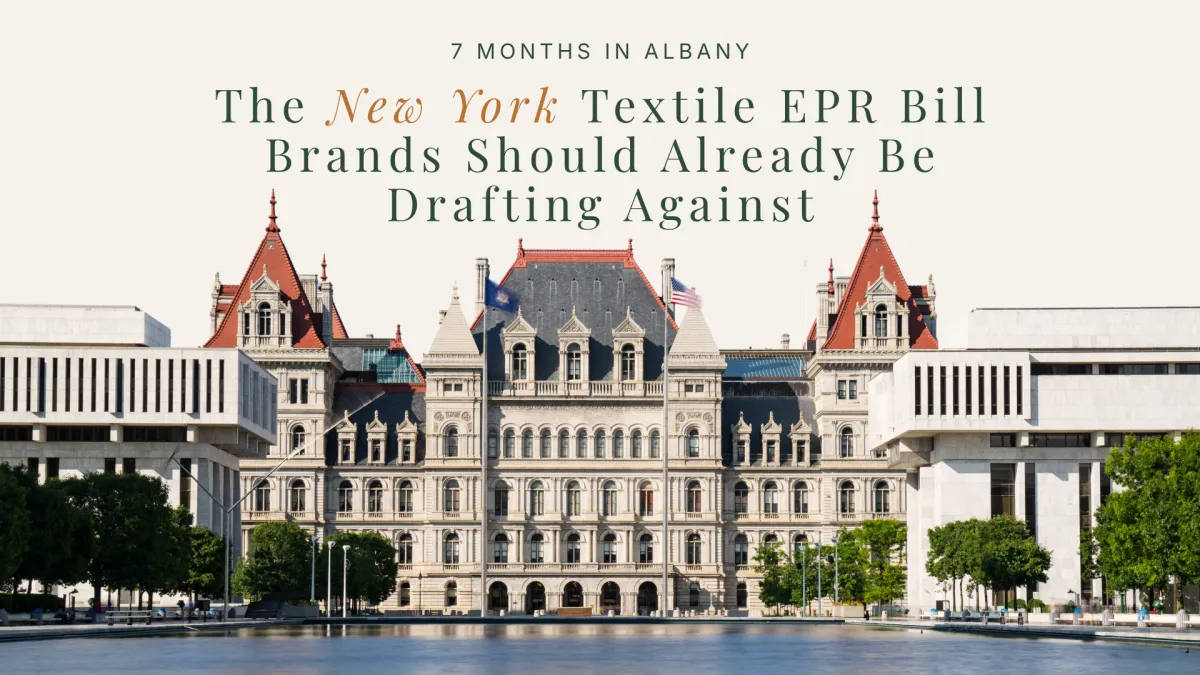
7 Months in Albany: The New York Textile EPR Bill Brands Should Already Be Drafting Against
A VP of sustainability at a mid-sized apparel brand has California's SB 707 work on one whiteboard. On the wall next to it, in a different colored marker, is a single line. "NY?" A question mark, no date underneath. The empty space is the harder problem. It is the work that gets put off until it is too late to do well.
Two bills in Albany would change the meaning of that question mark. Senate Bill S3217-A, from Senator Kavanagh, and its Assembly companion A6193-A, from Member of Assembly Kelles, would put extended producer responsibility for textiles into New York's Environmental Conservation Law. The Senate bill, as currently amended, would require producers to submit a collection program plan by December 31, 2026.
If the bill becomes law this session, brands selling in New York have about seven months from today to the first thing the law would ask for. The work to do that, done well, takes longer than seven months.
What the Bill Actually Asks Producers to Submit
The Senate bill would require producers of covered textile products to submit a collection plan to the Department of Environmental Conservation by the end of 2026. The Assembly bill adds more. A ban on landfilling textiles within three years of enactment. A thirty percent post-consumer content minimum within five years for covered products.
A plan is not a one-page filing. It identifies the producer. It names every covered SKU in the catalog. It describes the collection program. It sets targets. It explains how the program will be funded. In other states that have run this process, a credible plan has taken months of data work before drafting, and more months of legal and operational review before filing.
The civil penalty in the Senate bill is real. The Department may impose penalties of up to one thousand dollars per violation per day. Higher tiers apply to repeat violations.
Substantially higher tiers apply to producer responsibility organizations themselves. A late filing, or a filing the Department finds weak, is not a paperwork problem. It is a continuing exposure.
Why California Compliance Does Not Cover Albany
A brand that did thorough SB 707 work has something useful. A documented covered-products list. A defensible record of material composition by SKU. A working relationship with a textile PRO. That work is reusable. It is not enough.
The New York bills differ from SB 707 in scope and timing. The definition of "covered textile" is not the same. California assumes one PRO. New York, as drafted, contemplates a different model with different reporting cadences and different penalties. A brand that treats New York as a copy of California will find the differences during submission, which is a costly place to find them.
There is also S8502, the Fast Fashion Waste Responsibility Act, introduced in September 2025 by Senator Parker. It is a related but separate statute. A brand preparing for the S3217-A deadline should also watch S8502. The two laws would not necessarily produce one set of obligations.
The Work That Compresses and the Work That Does Not
Some work compresses under deadline pressure. Drafting the narrative parts of a plan. Running the legal review. Building the public-facing communication around the filing. A good team can move quickly once the inputs are ready.
Other work does not compress. Identifying every SKU that meets the legal definition of "covered" when the catalog has thousands of items and the bill of materials lives across vendor systems is months of data work. Verifying material composition at the level a credible filing requires, when suppliers are not consistent in how they report, is more months. Negotiating a PRO relationship, if there is one, takes weeks at minimum.
The brands that will be ready for December 31, 2026, if the bill passes, are the brands whose material and supplier data are already clean. The brands whose data are not clean cannot clean them in seven months and write the plan that depends on them.
The Infrastructure Case
A brand that built SB 707 as a one-off project, scoped to California and closed when enrollment was done, will build New York from scratch. A brand that built SB 707 as infrastructure, with covered products, material composition, and supplier attestations in a single system the brand owns, can adapt to New York in weeks.
This is the case Amalé makes to brands across the compliance landscape. The work that compounds is the paperwork. The work that does not compound is the state-by-state project. The Albany bill is one in a long line of state filings. Brands that treat each as a new project will spend the decade rebuilding the same record. Brands that treat the record as the asset will spend it on the work that matters.
What to Do This Month
A brand that sells real volume into New York should do three things between now and the next session update.
Track the status of S3217-A and A6193-A weekly. Name one person inside the company who owns the watch. Bill status shifts during a session. A brand that learns about enactment three weeks late has lost three weeks of seven.
Start covered-products identification now, before the bill passes. Assume the definition in current bill text is close enough to the final one. The list can be refined later. It cannot be built later.
Open a conversation with whoever is likely to run the program in New York. Those conversations take weeks. Brands that start them early will have options that brands starting them in November will not.
Key Takeaways
S3217-A currently sets a plan deadline of December 31, 2026 if enacted. The work to produce a credible plan takes longer than seven months.
The bill is not yet law. It has been amended and recommitted. Bill status should be tracked weekly by a named owner inside any brand selling in New York.
SB 707 readiness is reusable but not enough. The covered-textile definition, the PRO structure, and the penalty regime in New York differ from California in ways that matter.
The work that compounds across state filings is the underlying record: covered products, material composition by SKU, supplier attestations. The work that does not compound is the project management around each state.
The Loop Report is a publication of Amalé Technologies Inc. The information provided is for educational and strategic purposes and does not constitute legal advice. For specific SB 707 compliance strategies, consult with your legal counsel and the official Landbell/CalRecycle documentation.