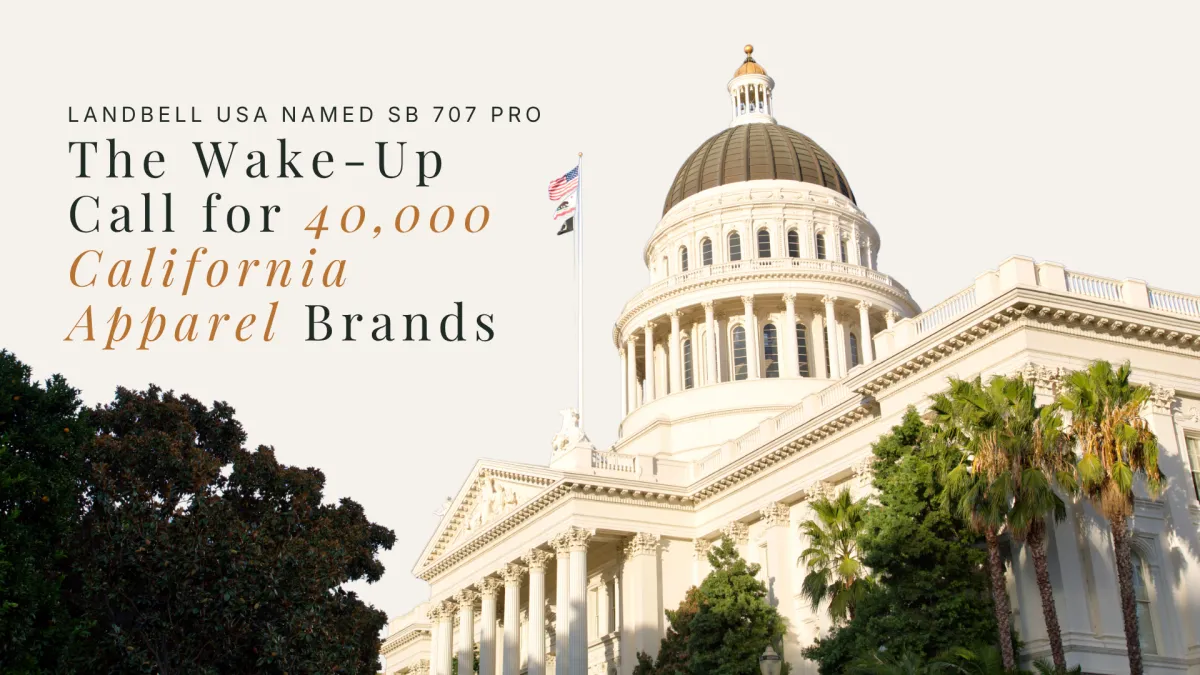
Landbell USA Named SB 707 PRO: The Wake-Up Call for 40,000 California Apparel Brands | Amalé
The End of the Experimental Era
For three years, the American fashion industry treated the California Responsible Textile Recovery Act (SB 707) like a storm still sitting offshore. Visible, yes. Immediate, no. That changed on March 1, 2024, when CalRecycle formally selected Landbell USA as the state’s first Producer Responsibility Organization (PRO).
This is the operational turn the industry has been waiting for. Landbell USA’s appointment moves SB 707 from legislative text into a real program with a defined implementation partner. It is no longer a question of if the industry will fund recovery. It is now a question of how brands will organize, verify, and share the data required to participate in a state-governed system.
The scale of this shift is hard to overstate. California is building the first statewide textile recovery system in United States history. By selecting a PRO with deep roots in global compliance, the state has made its position clear. The loose, fragmented approach to textile disposal is being replaced by a coordinated, accountable model. For the C-suite, that means one thing: the move from "voluntary responsibility" to "regulated obligation."
40,000 Thresholds of Accountability
The "40,000" figure is not hyperbole. It is the estimated number of producers, from global luxury houses to mid-market retailers, that sell into California and meet the $1 million annual revenue threshold. For those companies, Landbell USA’s appointment starts a real timeline and creates a practical framework to work against.
The law is straightforward. Any brand that sells apparel, footwear, or textile products in California must participate in the PRO-led program. By July 1, 2026, those brands must be registered. If a brand does not register, the statute allows for civil penalties that could reach $10,000 per day. The smartest move is to treat that enforcement reality as a planning input, not a scare line, and build an audit-ready path now.
The human story behind these numbers lives in the offices of sustainability leads and CFOs across the country. For years, many of these teams managed circularity as a voluntary PR effort or a contained pilot. Now they are being asked to run it like an operating function. It is a little like the moment a household budget stops being a note on the fridge and becomes something you review line by line at the kitchen table. End-of-life product impact is becoming a measurable obligation. That means precise data, material transparency, and a direct financial contribution. Brands do not have to figure this out alone. With the right infrastructure, the work becomes manageable: define scope, organize product data, enroll, and report with confidence.

Why Landbell USA Changes the Physics of Compliance
Choosing the operator for this system required more than local presence. It required a partner capable of handling the coordination and data demands built into SB 707. Landbell Group brings deep European EPR (Extended Producer Responsibility) experience to California. They understand the mechanics of recovery, how materials are tracked, sorted, and reprocessed at real scale.
Under Landbell’s stewardship, the PRO will be responsible for:
Developing the Collection Infrastructure: Building the physical network of bins, sortation centers, and logistics chains that currently do not exist at scale.
Setting Fee Structures: Determining how much brands will pay based on the volume and "circularity" of the materials they put onto the market (eco-modulation).
Reporting and Transparency: Providing CalRecycle with the granular data required to prove that California is actually diverting textiles from landfills.
For brands, this means the era of "approximate" data gets harder to defend. A state-governed program needs consistent definitions, repeatable calculations, and records that hold up over time. The goal is not perfection overnight. The goal is a credible baseline and a system that improves each cycle, SKU by SKU, season by season. The reality is simple: the more complex your supply chain, the earlier your data architecture needs to be in place.
The Infrastructure of Memory
At Amalé, we view fashion as more than a commodity. It is intimate human expression. It holds memory. When a garment is discarded into a landfill, something real is lost, not just material value, but the record of the resources, labor, and care that made it. Every thread has an origin. Most people know the feeling of finding an old jacket in the back of a closet and instantly remembering who they were when they wore it. For too long, the industry has worked as if that record disappears once the sale is complete.
The Circularity Engine™ was built for this exact inflection point. We believe compliance should not feel like dead paperwork. It should reflect operational integrity. By centralizing data and automating the transparency required by SB 707 and the upcoming EU Digital Product Passports (DPP), we help brands preserve the full lifecycle record of what they make.
Compliance infrastructure is the operating system of this new era. Without it, a brand’s design vision and product story cannot stand up to the regulatory scrutiny ahead. Landbell USA will provide the bins and the trucks. Amalé provides the compliance infrastructure that gets a brand’s data ready for the road.

An aerial view of used clothes discarded in the Atacama Desert, Alto Hospicio, Iquique, Chile, on September 26, 2021. Photograph by Martin Bernetti/Getty Images.
Beyond the Spreadsheet: The Circularity Engine™
A common planning error is treating SB 707 as a simple fee. It is more than a fee. It is an operational shift that touches product data, vendor inputs, and reporting cadence. If you wait until June 2026 to organize your material data, you will be building under pressure. Start earlier, and the work becomes measurable, staged, and far less disruptive.
The Amalé Circularity Engine™ is designed to close the gap between a brand’s current data silos and the reporting requirements that will flow through the PRO. We provide secure, exclusive infrastructure to generate Digital Product Passports at scale so compliance becomes a managed workflow, not a fire drill.
When you can prove the origin, composition, and recyclability of a garment through a Digital Product Passport, you are meeting a California requirement while also building a repeatable foundation for the EU Digital Product Passport framework. Amalé’s role is clear: we are the infrastructure layer, not the regulator. Landbell and CalRecycle define the rules and run the program. Amalé helps brands assemble the underlying product facts and produce outputs that are consistent, auditable, and ready when deadlines hit.

The C-Suite Takeaway: A Checklist for the 104-Day Sprint
The clock is ticking toward the July 1 deadline. Here is what the leadership of any brand selling in California should prioritize immediately:
Confirm Your Status: If your brand generates over $1M in annual revenue and sells textiles in California, you are a "producer" under SB 707. Start by confirming scope and product categories internally.
Audit Your Data Gaps: Do you know the fiber composition of every SKU at a level you can defend? Can you trace inputs far enough upstream to support reporting and fee modulation? Build a gap list, then close it in phases.
Evaluate Your Infrastructure: Is your data sitting in a static spreadsheet, or is it structured for integration and repeatable reporting? Treat compliance as a system, not a one-time submission.
Engage the Right Partners: Choose infrastructure that respects the reality of your products and your operations. The goal is less stress, fewer surprises, and a path your teams can actually maintain.
The appointment of Landbell USA is a practical signal: the program is moving from concept to implementation. Brands that begin now will have options, more time to validate data, align stakeholders, and build a repeatable process. Amalé is here to support that work with calm, high-integrity infrastructure. This is not a theoretical shift anymore. It is a new operating requirement for brands that plan to stay ready, credible, and in market.
Legal Footer: This publication is for informational purposes only and does not constitute legal or financial advice. Compliance requirements under California SB 707 and EU DPP are subject to change based on regulatory updates from CalRecycle and the European Commission. Brands are encouraged to consult with legal counsel and official PRO representatives to ensure specific compliance with all state and international laws.
Amalé is the Circularity Engine™ for the next era of fashion. We provide the infrastructure that turns compliance into a competitive advantage. Visit amale.com to learn more.