Why Fashion's Circular Goals Are Failing Without Textile Collection Infrastructure | Amalé
The Architecture of Failure: Beyond the Dented Bin
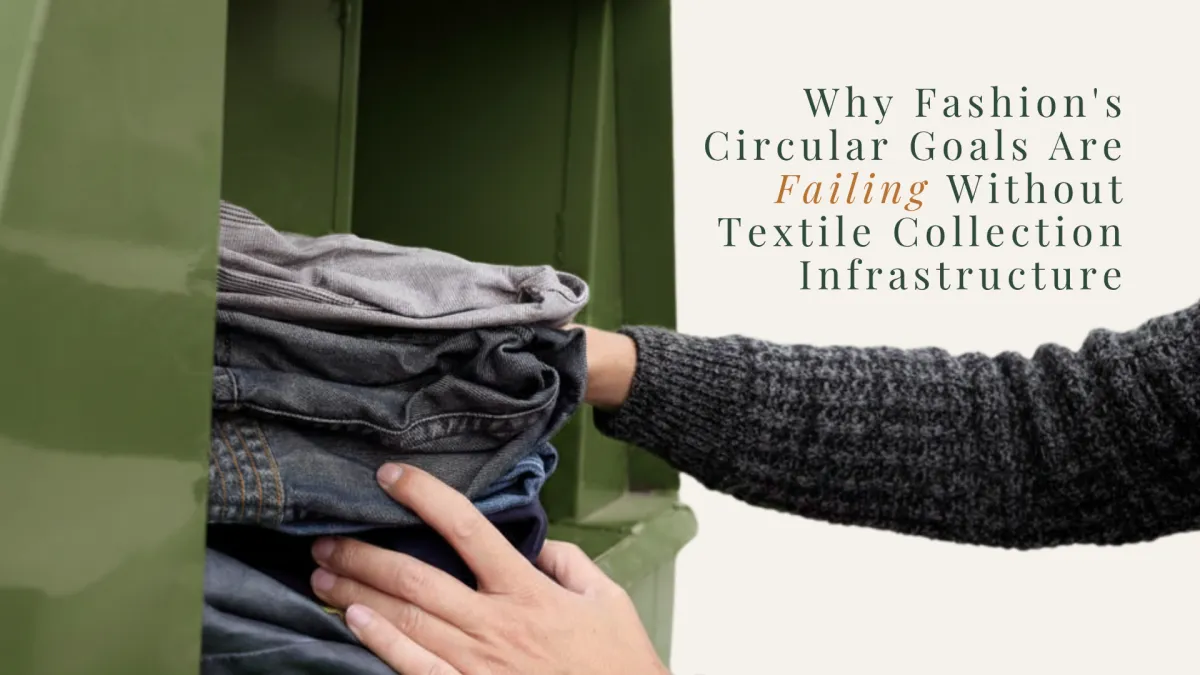
For decades, the fashion industry’s approach to circularity has been relegated to the periphery, literally. We have placed the burden of textile recovery on dented metal bins tucked into the corners of supermarket parking lots, often surrounded by caution tape and overflowing with unrelated debris. Most of us know the feeling of carrying something valuable in a flimsy bag and hoping it makes it home intact. That is what this system asks of garments that still hold material and commercial value. This is not infrastructure; it is an afterthought. It is a utility grade solution for a high value resource problem.
Currently, the global economy is moving backward. The share of secondary materials in the global economy declined from 9.1% in 2015 to a staggering 6.9% in 2021. Despite billions of dollars in corporate "commitments," only 8.6% of the world economy is truly circular. This decline is not a failure of intent, but a failure of architecture. We have attempted to build a circular future on a linear foundation that treats garments as "waste" rather than high-potential feedstock.
Research indicates that a staggering 79% of individuals report frustration with neighbors and community members over poor recycling practices, largely because overflowing bins and inadequate provision prevent proper disposal. In high-density areas, those relying on communal bins face 25% more challenges than those with individual access. When 33% of people cite a lack of physical space or access as a critical barrier, we must acknowledge that the "parking lot" model has reached its structural limit.
At Amalé Technologies, we view this as a structural crisis. The "Battle of the Bins" refers to the chaotic, uncoordinated scramble for physical recovery points that lack the digital precision required to actually close the loop. When a garment enters a bin, it often disappears from view. It is a little like checking a suitcase with no tag and hoping it reaches the right destination. Without traceability, that garment loses value and becomes part of the "leakage" that costs the industry millions in lost material potential. We need to move beyond the "trash" mindset and build recovery architecture that matches the value of the materials being handled.

SB 707: The Structural Foundation of Recovery
The landscape changed permanently with the arrival of California’s SB 707, the Responsible Textile Recovery Act. This is not merely a new set of rules; it is the structural foundation for a new era of fashion. It mandates that brands take responsibility for the entire lifecycle of their products, effectively outlawing the "parking lot" model of accidental recovery.
SB 707 requires a level of precision that off the shelf software cannot provide. This is enterprise grade compliance that demands a sophisticated marriage of physical logistics and digital oversight. The law necessitates a transition from passive participation to active stewardship. For the 40,000 brands impacted by this legislation, the regulatory floor has been raised.
The underlying issue is that the textile recycling system has remained largely unchanged for decades. It fails to cope with increased volumes and complex material blends. The circular economy principle of keeping resources in circulation requires design and manufacturing to be implemented in ways that make recovery easier and more obtainable. However, current systems remain reactive.
Compliance is the driver of this architectural shift. By mandating a Producer Responsibility Organization (PRO) and rigorous reporting, SB 707 pushes brands to treat their supply chains as closed loop systems. However, the legislation only provides the mandate; it does not provide the tooling. That is where the distinction between a regulator and an infrastructure partner becomes critical. While entities like Landbell and CalRecycle govern the standards, Amalé Technologies provides the Circularity Engine™. It is the enterprise grade infrastructure required to meet those standards with precision.
The Circularity Engine™: Digital Precision for a Physical World
The primary obstruction to true circularity is not a lack of bins, but a lack of integrity in the data those bins collect. Mechanical recycling requires clean, homogeneous inputs. When disparate materials are commingled in a parking lot bin, the "green premium," meaning the higher cost of recycled materials compared to virgin ones, skyrockets because of the labor required to sort the mess.
We see the "Folding-Phobic" phenomenon in household recycling, where millions of people fail to compress materials, wasting valuable bin space and rendering the system inefficient. In the fashion world, this inefficiency is amplified. A garment thrown into a bin without a digital identity is a resource that requires manual, expensive intervention to identify.
The Circularity Engine™ by Amalé Technologies replaces this chaos with digital precision. We do not offer a "plug and play" fix; we provide bespoke infrastructure that integrates with a brand’s existing architecture. Through the use of Digital Product Passports (DPP), every garment becomes a data rich asset.
When a garment reaches its "point of return," it is no longer a mystery. Its material composition, provenance, and recycling instructions are instantly accessible. This precision eliminates "leakage" and ensures that high quality textiles are diverted from landfills and returned to the production cycle. We are transforming the physical challenge of zoning and bin placement into a streamlined digital workflow. This is resource recovery architecture: a system where data flows as seamlessly as the textiles themselves.

The July 1 Deadline: From Triage to Action
The industry is currently facing an inflection point. By July 1, 2026, brands must be enrolled in a PRO to remain compliant with California law. This date represents a "vibe check" for the entire fashion sector. Brands that continue to rely on fragmented, utility grade solutions will find themselves structurally unable to meet the reporting and recovery requirements.
The urgency of this deadline cannot be overstated. We are moving from a period of voluntary sustainability gestures to a period of mandatory structural compliance. This is "The Great Sorting." On one side are the brands that treat this as a bureaucratic hurdle; on the other are the brands that recognize SB 707 as an opportunity to rebuild their recovery architecture from the ground up.
Amalé Technologies is the partner for the latter. We provide the enterprise grade tooling necessary to navigate this transition, turning the burden of paperwork into a strategic advantage. Our platform helps brands see compliance not as a series of obstacles, but as a clear map of material flow.
Scaling the Bespoke: The Future of Resource Recovery
True circularity cannot be achieved through a one size fits all approach. Every brand has a unique DNA, a unique supply chain, and a unique relationship with its customers. The future of the fashion industry lies in scaling the bespoke: creating high end infrastructure that is as refined as the garments it recovers.
We must stop viewing recovery as "waste management." Waste is a design flaw. In a properly architected system, every output is an input for something else. By moving the circular economy out of the parking lot and into a digitally fortified recovery network, we preserve the value of the craftsmanship and the intimacy of the garment.
Amalé Technologies is committed to this standard. We are not here to help you "get by" with a few more bins; we are here to build the infrastructure that makes those bins obsolete. It is similar to finally replacing a paper map with a real navigation system. You stop guessing and start moving with direction. We are building a world where traceability is the standard, and where the circular economy is no longer stuck in the parking lot, but becomes part of the industry’s core operating model.
Legal Disclaimer:
The Loop Report is a publication of Amalé Technologies Inc. The information provided is for educational and strategic purposes and does not constitute legal advice. For specific SB 707 compliance strategies, consult with your legal counsel and the official Landbell/CalRecycle documentation.