
MEASURABLE CIRCULAR IMPACT
Impact you can measure.
Compliance you can prove.
Every tonne of textile waste diverted from landfill carries a measurable outcome. Amalé tracks the data that makes circularity real, reportable, and verifiable.
The Problem No One Has Fully Solved
System of a Down
• 73% of clothing materials are landfilled or burned
• Fashion = 10% of all global CO2e emissions
• Less than 1% is recycled into new clothing
• 92M+ tonnes of textile waste produced globally each year
No Infrastructure Exists
• No shared system tracks products beyond checkout
• Product data dies at point of sale
• ESG reporting requires data brands don't have
• Can't monetize circular pathways without tracking
Regulation Is Global
• California: EPR Compliance in effect for summer 2027
• France: Operating since 2007, expanded requirements
• EU: Digital Product Passports mandatory 2027, implementing EPR by 2028
• New York & Washington: EPR legislation under review
* A pile of discarded clothes in the Atacama Desert, northern Chile, as seen by a satellite.
THE SCALE OF THE PROBLEM
The system we are replacing.
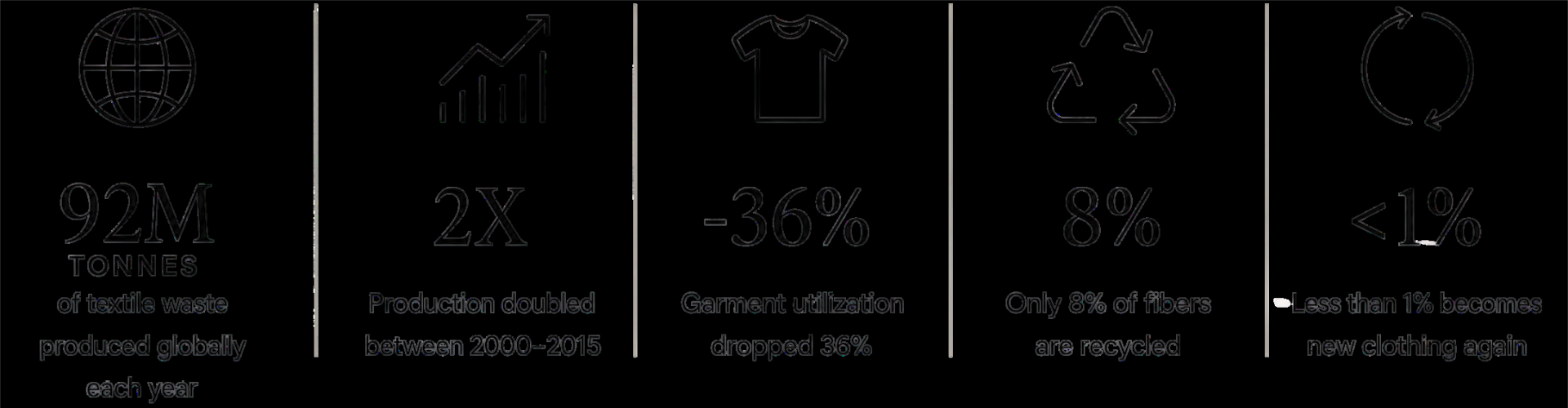
Over $100 billion in material value is lost annually. This is not a waste problem. It is a system failure.
Sources: UNEP, Ellen MacArthur Foundation, CalRecycle, EU ESPR
THE PLATFORM BEHIND THE NUMBER
Circular impact needs infrastructure.
Amalé does not move textiles. We make product movement measurable.
We make:
product data legible
compliance reporting easier
impact measurable
Every brand on our platform knows: what they sold, what it is made of, and where it goes at end of life.
OUR COMMITMENT
For every 1 million tonnes of textiles tracked and diverted through the Amalé platform, our goal is to reach these targets.
IMPACT GOALS →
20M
Tonnes
CO₂e AVOIDED
Climate Impact
~2.7T
Liters
WATER SAVED
Resource Impact
$70M
Landfill
COSTS AVOIDED
Economic Impact
5 MILLION TONNES DIVERTED BY 2030
THAT IS OUR TARGET.
For every 1 million tonnes of textiles tracked and diverted through the Amalé platform, impact becomes measurable. Our 2030 target scales that commitment to 5 million tonnes.
It represents roughly 4% of annual U.S. textile waste. Ambitious, achievable, and directly tied to the brands operating on our platform.
This is what that number means in practice.
CLIMATE IMPACT
100 million
tonnes of CO₂e avoided
The fashion industry already produces 1.2 billion tonnes of CO₂ annually, more than international aviation and maritime shipping combined.
Diverting one tonne of textiles prevents approximately 20 tonnes of CO₂ emissions from landfill decomposition and virgin production.
RESOURCE IMPACT
~1.3 trillion liters of water saved
Textile production consumes 93 billion cubic meters of water annually.
Every garment kept in circulation reduces the need to extract and process new resources.
At 5 million tonnes diverted, the impact is measurable at a watershed level.
ECONOMIC IMPACT
$350 million in landfill costs avoided
In 2018, U.S. landfills received 11.3 million tons of textile waste, accounting for 7.7% of total municipal solid waste.
The cost of managing that waste falls on municipalities and taxpayers.
Amalé enables brands to stop
contributing to that system.
Help build the system that replaces waste.
The future of circularity is shared. Let’s build it together.

